Whenever I look back at the long and rich history of the FIFA World Cup, one thing always amazes me. The tournament has grown from a simple global contest into one of the most powerful financial engines in world sport. And FIFA World Cup Prize money tells a very interesting story.
It reflects the explosion of television rights, the rise of digital coverage, the growth of sponsorships, and the ever expanding global passion for football. Prize money is now a major talking point, as the FIFA World Cup 2026 is near.
Let’s get through the history of FIFA World Cup prize money, because it reflects not just performance rewards but the massive commercial reach of the event itself.
Components of the World Cup Prize Money (Specifically, It is the Total Distribution Fund)
When you hear that FIFA allocated a certain amount for a particular World Cup, that number does not represent prize money alone. It usually includes several categories. I want to explain these clearly so the rest of the article makes complete sense.
1. Prize Money
It refers to the direct reward for national teams based on how far they go in the tournament. Teams receive more as they progress deeper, with the champion receiving the highest amount. While the teams that get eliminated from the group stage receive the lowest.
2. Preparation Payment
Every team that qualifies for the World Cup receives a guaranteed preparation fee. It covers travel, training camps, and essential logistics. In this way, there is very little financial burden on federations.
3. Club Benefits Programme
Modern football relies on professional clubs that develop and train players. Since clubs release their players to national teams during the World Cup, FIFA compensates clubs for every player who participates in the tournament.
4. Club Protection Programme or Insurance
If a player is injured while representing his national team during the World Cup, FIFA compensates the club financially for the loss of the player during his recovery. This insurance structure became significantly more important in recent decades.
5. Other Costs
FIFA also directs part of the distribution pool toward organizational and administrative expenses related to the tournament as well as legacy projects that support football development in the host nation.

How Does FIFA Create the Prize Money Fund?
The FIFA World Cup is the main reason FIFA stays financially strong. Every four years, the organization sells global television rights along with digital streaming rights and major sponsorship packages. Ticket sales, hospitality packages, licensing programs, and merchandising all feed into the same revenue stream.
Since the World Cup cycle spans four years, the money collected throughout this period combines to form a massive financial pool.
- The majority of this pool money came from television rights, which continue to be the strongest pillar of revenue.
- Sponsorships stood in second place, followed by ticket and hospitality income.
After covering administrative expenses, event production, insurance obligations, and global development programs, a major share of the pool is dedicated to the teams that participate in the World Cup, along with football federations, club programs, and developmental work. The prize money that fans usually talk about is only one part of an even bigger structure.
FIFA’s 2015-2018 Financial Cycle – The Best Example of How FIFA’s Financial Cycle Generates Money
This cycle is a great example because FIFA released detailed figures. Between 2015 and 2018, FIFA generated more than $6.42 billion. From this, 85% was generated only from the FIFA World Cup 2018 ($5.357 billion).
According to FIFA’s Official Financial Report for the 2015-2018 World Cup Cycle, the revenue split is:
| Category | 2015 | 2016 | 2017 | 2018 | TOTAL |
|---|---|---|---|---|---|
| Television broadcasting rights | $258 million | $96 million | $229 million | $2,544 million | $3,127 million |
| Marketing rights | $157 million | $115 million | $245 million | $1,143 million | $1,660 million |
| Licensing rights | $51 million | $204 million | $160 million | $185 million | $600 million |
| Hospitality/accommodation rights and ticket sales | N/A | N/A | $23 million | $689 million | $712 million |
| Other revenue | $78 million | $87 million | $77 million | $80 million | $322 million |
| TOTAL | $544 million | $502 million | $734 million | $4,641 million | $6,421 million |
$791 million was used as prize money fund for the FIFA World Cup 2018. FIFA kept around $400 million as administration costs, around $420 million was spent on TV coverage production costs, and $390 million was invested to help organize the World Cup 2018. Another $120 million was awarded to the Russian football federation for organizing the tournament.
Besides, a large portion is spent on helping develop football around the world by providing financial assistance to football federations worldwide.
FIFA World Cup Prize Money Breakdown (1982 to 2022)
Now that we have the idea of all essential elements, let me take you through the FIFA World Cup Prize Money breakdown (year by year) and see how the money evolved.
| World Cup Year | Total Fund | Winner Prize |
|---|---|---|
| 1982 Spain | $20 million | $2.2 million |
| 1986 Mexico | $26 million | $2.8 million |
| 1990 Italy | $54 million | $3.5 million |
| 1994 United States | $71 million | $4 million |
| 1998 France | $103 million | $6 million |
| 2002 Korea and Japan | $154 million | $8 million |
| 2006 Germany | $262 million | $20 million |
| 2010 South Africa | $420 million | $30 million |
| 2014 Brazil | $564 million | $35 million |
| 2018 Russia | $791 million | $40 million |
| 2022 Qatar | $1,000 million | $42 million |
Beginning Years – When Hype Was High But Financial Figures Were Small (1982 – 2010)
I want to begin with the early years, when the financial side of the tournament was far less glamorous compared to today.
- World Cup 1982 in Spain: The prize fund for this tournament was around $20 million. The champion received a little more than $2 million. At that time, there were twenty four qualified teams, and football was in an entirely different financial era. Television rights were valuable, but nowhere near the colossal figures we see today.
- World Cup 1986 in Mexico: The prize pool increased to around $26 million, and the champion earned around $2.8 million. It was a small increase, but still a steady sign that FIFA was moving toward commercial expansion.
- World Cup 1990 in Italy: By 1990, the total fund had more than doubled to $54 million. The champion took home $3.5 million. The rise in television distribution and the introduction of more structured sponsorship agreements played a major role here.
Middle Years – When FIFA’s Financial World Started Evolving (1994 – 2010)
From the FIFA World Cup 1994, the financial aspects have started dominating, as more and more people have gained access to the live streams, which boosted the value of broadcasting rights. Let’s go through it.
- World Cup 1994 in the United States: This edition became a turning point for global football. The total fund rose to $71 million. The champion received $4 million. The United States delivered strong broadcasting numbers, which encouraged sponsors to invest heavily in future tournaments.
- World Cup 1998 in France: The prize pool grew once again, reaching $103 million. The winner took home $6 million. FIFA introduced more formal revenue structures, and the team count expanded to thirty two. This expansion allowed FIFA to negotiate broader rights packages.
- World Cup 2002 in Japan and Korea: For the first-ever joint-hosted World Cup, the fund expanded to more than $154 million. The champion received $8 million. Preparation payments also appeared in a more structured form, which marked an important evolution.
- World Cup 2006 in Germany: Germany delivered one of the most commercially successful tournaments. The total fund reached $262 million. The champion received $28 million. Preparation funds and club support payments became more clearly defined.
- World Cup 2010 in South Africa: The total distribution fund increased to more than $420 million. The winner took home $30 million. It was also the point where FIFA significantly expanded its insurance commitment to clubs.
Modern Era – World Cup Prize Money from 2014 to 2022
From this point onward, FIFA began sharing detailed financial breakdowns. So I will explain these editions in depth.
1. World Cup 2014 in Brazil
Brazil hosted one of the most passionately supported tournaments in recent memory. FIFA allocated a total fund of $564 million for the participating teams and associated programs.
Below is the detailed breakdown for 2014:
| Category | Amount |
|---|---|
| Total Fund | $576 million |
| Prize Money | $358 million |
| Club Benefits | $70 million |
| Club Protection (Insurance) | $100 million |
| Preparation Payment | $1.5 million for each of the 32 teams |
| Other Costs | Legacy programs, development funding, and administrative spending |
The champion, Germany, received $35 million. Every team also received preparation funding long before the event began.
2. World Cup 2018 in Russia
The 2018 edition brought another financial leap. FIFA confirmed a total distribution of $791 million. This amount was made available to national teams, clubs, and protection programs.
Here is the detailed financial table.
| Category | Amount |
|---|---|
| Total Fund | $791 million |
| Prize Money | $400 million |
| Club Benefits | $209 million |
| Club Protection (Insurance) | $134 million |
| Preparation Payment | $1.5 million for each of the 32 teams |
| Other Costs | Administrative and event-related FIFA costs |
The champion, France, received $40 million. The runners up Croatia, took $30 million. Even group stage teams received $8 million each, in addition to their preparation fee.
3. World Cup 2022 in Qatar
The most recent tournament produced the largest prize pool in history. The performance based prize money alone reached $440 million. When combined with club benefits and preparation payments, the total distribution created by FIFA for this tournament was widely recognized as close to $1 billion.
Here is the complete breakdown for 2022:
| Category | Amount |
|---|---|
| Total Fund | Around $1 Billion in total allocations by FIFA |
| Prize Money | $440 million |
| Club Benefits | $209 million |
| Club Protection (Insurance) | Not itemised in public FIFA reports |
| Preparation Payment | $1.5 million for each of the 32 teams (48 million total) |
| Other Costs | Organizational, administrative, and event costs listed in the FIFA financial report |
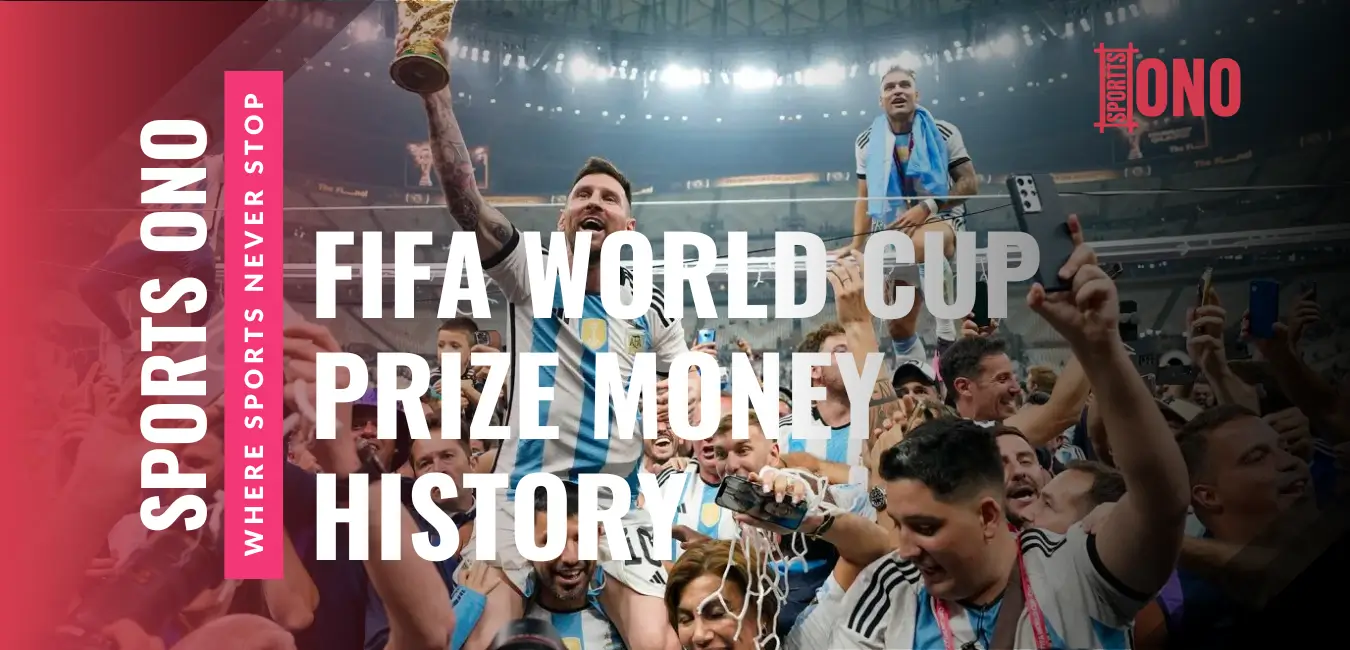
The champion Argentina took home $42 million. France received $30 million. The third placed Croatia earned $27 million, while Morocco received $25 million for finishing fourth. Even teams that left the tournament in the group stage earned $9 million each.
Why the FIFA Prize Money Grew So Rapidly?
From 1982 to 2022, the prize money structure increased from $20 million to $400 million in performance payments alone. There are several clear reasons for this dramatic change.
- Massive Television Revenue: The reach of the World Cup has grown significantly. Billions of viewers tune in from every corner of the world. This allows FIFA to negotiate incredibly powerful rights packages with broadcasters.
- Global Commercialization: Sponsors view the World Cup as the strongest marketing stage on the planet. This injects millions into the overall revenue cycle.
- Digital Expansion: Streaming services, mobile rights, and online advertising have transformed how fans watch football. It created entirely new income streams that never existed in earlier decades.
- Increased Professionalism: Football development programs, player training systems, and support structures have become more advanced and more expensive. Prize money helps federations fund these systems across the world.
- Fair Compensation for Clubs: With players representing national teams during the World Cup, clubs deserve and receive financial support. This has become a valuable and respected part of the distribution structure.
What the Future of World Cup Prize Money Might Look Like?
Looking ahead to the expanded format of the tournament in 2026, I expect prize money to grow once again. With 48 teams and larger hosting markets, the financial pool is almost guaranteed to rise.
FIFA has already hinted at further increases in club benefits and developmental investments. The trend is clear. Every cycle creates more revenue, and every edition increases the money flowing back into the sport.
Let’s Rewind
The story of FIFA World Cup prize money from 1982 to 2022 shows how football has transformed into a global financial powerhouse. What began as a modest prize pool of $20 million has evolved into a sophisticated distribution system that rewards national teams, supports clubs, protects players, and funds football development across the world.
As the commercial strength of the tournament continues to grow, so will the financial rewards for every team that earns a place on the biggest stage in world sport. I hope this guide has helped you understand how deeply the World Cup has changed and how the prize money structure reflects that incredible journey.
About the Author